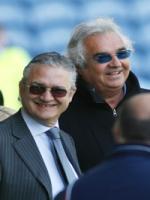
 Monday, 28th Nov 2011 23:37 by Clive Whittingham The Four Year Plan, a behind the scenes look at the Flavio Briatore reign at Loftus Road, aired in Amsterdam last week as part of the International Documentary Festival. LoftforWords was there to see it. QPR fans, it seems, are not the most perceptive group of supporters in the Football League. Never shy of sticking two together with two and running off to the nearest message board with a big fat five, but for the last four seasons missing an interesting story unfolding right under our noses. For literally years fans have greeted footage of Amit Bhatia and members of his family jumping around and celebrating QPR goals with such platitudes as “you can tell that Bhatia has got the bug” when in fact what they should have been asking is: “Who is filming this footage? And why?” The answer to those two questions is Mat Hodgson from Ad Hoc Films, and because he had seen in QPR the all too rare qualities that make football work in documentary form. The result of him perching on the front step of the directors’ box for the last three seasons and quietly following our billionaire owners around as they went about the business of making a complete pig’s ear of running a football club is The Four Year Plan which screened in Amsterdam at the International Documentary Festival (IDFA) last week. By some rare stroke of good fortune, I was there for work and got to see it. Good football films, fictional and factual, can be counted on the fingers of one hand. Strange, as you only have to look at the audience figures and ticket sales for the lamentably awful Goal trilogy to see that an appetite for such content is there. The arts and culture brigade tend to look down their nose at football somewhat and unless your documentary is about the Iranian women’s football team then you can pretty much forget it. In fact, if the line up at IDFA this November was anything to go by, unless you’ve got Iran, Israel or Palestine in there somewhere you can forget it whatever your topic. There have been, for my money, two excellent documentaries on British football. Yours for a Fiver, the story of the collapse of Leyton Orient prior to Barry Hearn’s takeover, and Do I Not Like That, the behind the scenes epic on Graham Taylor’s ill-fated quest to take England to the 1994 World Cup in the USA. On neither occasion was the quality of the filming or production up to much - the Orient documentary in fact was little more than a student project done by a budding local film maker - but they went down in history as the finest examples of the art.
The programmes’ success was down to the characters at the heart of it all. The Orient film makers found manager John Sitton who, during the course of the season and the film, had a very public nervous breakdown culminating in the infamous half time footage (still available on You Tube) where he puts one player on two week’s notice for his first half performance and offers another two a fight in the car park for which he tells them they will need to “bring your fucking dinner”. Taylor meanwhile and his “can we not knock it to Les” and “do I not like that” catchphrases had his nadir when England are harshly dealt with by the match officials in the crucial qualifier against Holland – “you’ve just cost me my job” he says politely to a linesman during a stoppage in play. Television gold. Four Year Plan could, and should, join them in footballing folklore. The production values are far higher and the characters are equally captivating and farcical. At the heart of it all is Flavio Briatore – the kind of central character more experienced film makers than Hodgson have waited 50 years to film and never managed to find. At the height of his reign stories of the lengths of his interference at QPR were ten a penny around the fan base. Everybody had a horror story to tell and most were just written off as the usual two and two makes five nonsense that populates the numerous QPR message boards. What this film tells you is not only was it all true, it was actually much worse than anybody ever imagined. Initially he was frequently at the training ground, the first team matches and even the reserve team games. In an excruciating but well cut scene from a second string game with Southampton at an empty Loftus Road scenes of Angelo Balanta falling over his own feet and missing the target from half a yard out are put together with shots Briatore in the director’s box alongside a silent Iain Dowie telling him there is a “virus” at the club that prevents people from scoring. Eventually Briatore orders Dowie to go downstairs and tell the players to start passing the ball to Damiano Tomassi more so Briatore can see how fit his star Italian signing is. Dowie does as he is told, sent on his way up the South Africa Road steps with a final piece of advice ringing in his ears: “and this goalkeeper is shit as well.” On the touchline the microphones pick Dowie up telling his assistant Tim Flowers that just because Flavio owns the club doesn’t mean Dowie has to do what he says. A short time later QPR lose 1-0 at Birmingham City, a game summarised in the car park afterwards by Briatore succinctly as: “last four games we’ve played bad football, finito.” And Dowie was finito later that week after a 0-0 draw at Swansea, despite the best efforts of sporting director Gianni Paladini to persuade Briatore that the result actually wasn’t a bad one. That was the film’s first managerial sacking completed before I’d even finished my bag of Revels. Briatore is featured near the beginning of the film on the front of a Birmingham City fanzine as Dr Evil from the Austin Powers film, with Bernie Ecclestone alongside him as Mini Me. The sight of this sends Amit Bhatia into roars of laughter on the back seat of the car insisting that they stop and buy a copy while Briatore sits in the front muttering under his breath. In fact the mini-me character is played more in the film by Paladini, who comes out of this very well in parts and absolutely awfully in others. Paladini splits his time on screen between trying to placate Briatore, and happily doing his dirty work to protect his own position. Prior to a league game with Cardiff City after the Dowie sacking Briatore is seen on the touchline with Paladini asking how he is going to be able to speak to caretaker manager Gareth Ainsworth during the game. Paladini initially does his best to quash the idea, saying it won’t look very good if Ainsworth is standing in the dugout either texting or talking on his mobile phone. The upshot of all of this though is that Paladini is sent down to do it himself, when Briatore sees Ainsworth’s refusal to bring on Gavin Mahon in the second half as him “choosing to lose the game”. Mahon comes on at Briatore’s, via Paladini, insistence and scores the winner leading to celebrations in the director’s box which had the packed Tuchinski theatre in Amsterdam in fits of laughter. Alejandro Agag, present throughout and with much more input than anybody seemed to realise at the time, jokes: “soon we’ll end up with Flavio in the dugout” and I really don’t think we were far from that at one point. Later, in an equally extraordinary scene, Briatore and Paladini, angry at then manager Paulo Sousa’s refusal to play two strikers in games, have decided that striker Dexter Blackstock should go on loan to Nottingham Forest. Blackstock, QPR’s top scorer at the time, is seen sitting at a table with a Forest contract in front of him shaking his head while other people in the room urge him “don’t sign it Dext, you don’t want to go.” Paladini, laughing and smiling, tells him it’s a good move for him and he should go and get some games. Suddenly, randomly, Fitz Hall arrives in the room demanding to know what’s happening and asking: “why are we loaning our top scorer out? Don’t we want to make the play offs?” Extraordinary scenes indeed.
Paladini is at his worst when Paulo Sousa is in charge – storming into the tunnel at half time to demand team changes, undermining the manager in front of his players and dressing him down in front of the Crystal Palace coaching staff who would of course eventually come and work for him. He clearly holds the Portuguese in contempt from the moment he arrives at the club and whereas his role with previous managers was to try and calm Briatore’s urge to sack them down, with Sousa Paladini actively encourages it and is seen twisting the knife on several occasions. That said, Sousa comes out of this film worse than most from his cringeworthy opening speech to the team, through some clips of extraordinary touchline behaviour, to a final meeting with the board where he comes across as a man totally out of his depth. Flavio Briatore started the film as a villain to me. I know the laughing stock he made of QPR and so I sat down ready to hate him and indeed initially that's what I did. Slowly though the audience around me started to laugh at him, and ultimately I was laughing too. He was so ridiculous he started to come across as one of the bad guys from the Naked Gun film – a character you would never have believed truly existed were the film not at a documentary festival. And this got me wondering about him. It seemed that he was something of a lethal combination – he wanted to win every single match, and was arrogant enough to believe that we should and that if we didn't then somebody must pay the price. But he also knew absolutely nothing about football. Neil Warnock’s first full season in charge started with 19 matches without defeat and QPR perched comfortably on top of the Championship. That run came to an end in a televised home match with Watford. As the second goal goes in Briatore, absent but watching on television, immediately phones Paladini in the director’s box to rant and rave about what he is seeing. It's one of the scenes that Paladini comes out of very well, barely concealing the exasperation in his voice as he points out that "sometimes, after 19 matches unbeaten, one of them goes against you." This was actually at a point in the film when Briatore started to come across a little bit better as well – as somebody who desperately wanted to win, realised he wasn’t helping with that and had taken a back seat. Warnock’s appointment at the time was very much billed as Briatore moving aside, Bhatia taking control and Warnock being his man but the film shows Briatore totally in agreement with the need for a new direction with a strong manager in charge – although Warnock is clearly a Bhatia and Saksena choice. This all followed a bizarre team meeting after the 5-0 defeat at Nottingham Forest where Hogan Ephraim's passionate, if a little high pitched, speech on "going 2-0 down and then just laying down and taking it" attracted praise from Flavio. Mikele Leigertwood's "errr, yeh, there's been quite a lot of change hasn't there, maybe that's upset us a bit" tubthumping Captain America impersonation is also a highlight of that scene. Briatore also impresses during the Faurlin transfer hearing saga, consistently cutting through the platitudes and brush offs from Paladini about how fine everything is by repeating the fact that “if everything is fine, why are they investigating us?” Briatore persistently asked questions of Paladini at that time that most of the QPR fans were asking themselves, which again only makes it more bizarre that Paladini managed to stay in position after that episode although throughout the film it’s clear that Paladini is the only one of them who really knows anything about football which may explain his Teflon like longevity during the Briatore reign. There are no new revelations on the Faurlin saga in this film by the way, but the feeling that we were very, very lucky is only increased by the look on Paladini’s face throughout the latter stages and his reaction when the verdict came in. Not that of a man who really believed everything was fine and the sky is blue. Briatore, Bhatia and Agag all seemed as oblivious and in the dark on what was going on as the rest of us.
But Briatore shows his true colours at the very end of the film, after the 1-1 home draw with Hull that promoted us in all but name. He is in fact, stark raving mad. Barmy in fact. "I don't understand this coach," he says of Neil Warnock who is about to lead QPR back to the Premiership for the first time in 15 years in his first full season in charge. "After all of this, after everything, now he's afraid to win." And no amount of cajoling from Amit Bhatia about only needing one more point could placate him. It’s very clear that one defeat, or in Warnock’s case one draw in a home match, put every manager at risk of Briatore’s wrath. “Every idiot we could have found, we found,” Briatore and Agag joke towards the end of the film when they reflect on the managers they appointed. “Not an idiot left untouched.” Strangely it never seems to occur to them that there should have been some discussion prior to or during the hail of bullets directed towards the dugout from Flavio about who might come in and replace the current incumbent should he be fired. Only for the appointment of Magilton is there any forward planning, and even then it only stretches as far as agreeing that whoever the new manager is should be told “these are the players you have got, you’ve got to make it work”. This certainly isn’t a film just for QPR fans, there are scenes here that raise enormous questions about who should be allowed to buy a football club and how the sport controls its finances. Bhatia is likeable throughout, Briatore is ludicrous and Bernie Ecclestone is largely absent but it’s clear from the start that none of them has a clue about the sport they’re involved in. Bhatia makes an effort to develop that understanding – he’s seen at a supporters’ meeting where John Reid from the LSA comes across very well, and in the away end at Birmingham where a group of the travelling fans don’t. Ecclestone is mentioned late on when he blocks Bhatia’s attempts to increase his stake to 50% in the club, much to the Indian’s annoyance and surprise. He also appears midway through reacting with horror to the amount of sports drinks piled up in the home dressing room telling Briatore that he needs to “cut down this expenditure” while the likes of Patrick Agyemang and Rowan Vine loiter in the background on colossal money without anybody saying a word. Another similar scene which speaks to the whole of football sees Bhatia and Saksena going through the club’s budget line by line and making decisions such as cutting down on the number of flowers in the executive boxes on matchdays and reducing the C Club menu from £10.80 a head to £9 - the upshot of which is a saving across the season of somewhere around £300,000. Bhatia concludes the meeting by congratulating everybody and thanking them for not including any cuts to the playing budget which of course includes scores of mediocre players on colossal contracts, many of whom were not even in the first team. This fiddling while Rome burns attitude to club finances is by no means limited to QPR as clubs up and down the land cut stationary orders and box office staff while throwing ever increasing amounts of money at the players. The film is cleverly interwoven with Evening Standard adverts charting the financial collapse of the country, a further nod towards the lunacy of football finance and a quality that should aid it in its ongoing search for broadcasters. Interestingly the scene with England manager Fabio Capello that attracted such attention from the Daily Mail after screenings in Marbella where Four Year Plan won the festival’s top prize has been cut. Hodgson, and QPR, got their Hollywood ending when the FA came down in QPR’s favour. As suspected, Agag’s plan had the decision gone the other way was to bury the Football Association in legal appeals for the entire summer but the scenes on the final day of the season are set so beautifully I actually found myself crying all over again at the sight of them. Hodgson sets it all up by filming around the deserted streets of Shepherds Bush in the early morning light with the very same radio news bulletin forecasting a warm day for the final day of the Championship season with nobody yet sure if QPR will be allowed to keep their trophy or not that I listened to during that insomnia laced week of torment in the background. Ultimately that was a fabulous day but watching this film - for which London screenings, possibly at Vue in Westfield, are being planned - it’s little short of a miracle that we made it. Links >>> Trailer >>> Interview with film makers Photo: Action Images via Reuters Please report offensive, libellous or inappropriate posts by using the links provided.
You need to login in order to post your comments |
   Blogs 31 bloggersUnited by Football, Divided by Race? Swansea City’s Asian Footballers and Racism in British Football by KeithHaynes Harrison who is studying towards a media qualification has written a very interesting piece on racism in football. It’s a very clear and well documented report. Follow him on X. @HYE15h. Football is often seen as a sport with a unique power to bring people together, connecting people from all over the world with different cultures, races and religions. 128 nations have featured in the topflight of English football, including 12 Asian nations. I have seen for myself how football connects people who otherwise have little in common through my support of Swansea City. These connections are epitomised by an exchange I had with South Korean tourists during a visit to London in August 2015. My three brothers and I were wearing our Swansea shirts, which South Korean tourists recognised because the South Korean captain, Ki Sung-yueng, was playing for our team. We connected over our shared admiration for Ki before having photos together. However, despite the unity football creates, racial incidents challenge the belief that football is a game for all. Kick It Out data shows there were 1,744 reports of discrimination, a record high last season, whilst racism reports against South Asians increased by 100%. This season we’ve already seen racial abuse allegedly directed at Swansea City’s Ji-Sung Eom during a game against Millwall. Former Swansea British Asian player Yan Dhanda was also subjected to racist messages online in 2021. Ki’s experience of racist chanting in Scotland in 2010 before joining Swansea shows that racism against Asians in British football is not a new phenomenon. In light of these incidents I will analyse the impacts of racial abuse against Asian players and football more widely, and ask if enough is being done to stop it. There are a multitude of different impacts from racial abuse within football, most notably the damage to player welfare. Yan Dhanda talked about the hurt he felt in the aftermath of his attack, stating how it affected both his family and how he was in training. Research by Osinnowo Kolawole reveals how the long-term emotional damage of racism is often unseen, affecting both personal lives and their performance. Racism can also lead players to question whether they want to continue playing football, as seen with Danny Rose. Osinnowo further states how racial trauma can lead to deep internal conflicts, with players altering their appearances to conform to white norms in football. For Lee Chun-Soo a former South Korean international footballer racist abuse left him with a desire to build a larger physique as a way of preventing further abuse. He believes the racial stereotypes about Asian players being small and weak results in a reluctance to recognise Asian players as equal competitors. This provides an example of an Asian player having to change who he is to be accepted into the sport, Lee and other victims of racism state how it can lead them to question their sense of belonging in the game. Premier League video content creator Kevin Yuan often faces racist abuse when filming at UK stadiums, despite living in the UK and following football since 2008, he states how he “feels like a foreigner, like I don’t fit in”. This challenge to a player’s sense of not belonging within the game has also had a severe impact on Asian participation with football in Britain, with just over 1% of professional players being of South Asian heritage. Whilst there are many factors which underpin this underrepresentation, racial abuse definitely plays a role. Research by Dr Stefan Lawrence reveals that overt racism within football academies from other players, makes British Asians feel like outsiders. Yan Dhanda talks about how during his time in football academies he was always told he wouldn’t make it due to his Asian background. For other Asian players lacking self-belief and support, abuse can prevent progression. Separate Asian teams and leagues have emerged in direct response to racism; these are seen as safe spaces for Asian players. Dr Lawrence has found that these separate teams and leagues do not have the same level of exposure as mainstream leagues, whereby they aren’t seen by scouts as repositories of talent. Furthermore, the lack of professional Asian players as role models not only limits young Asian players’ beliefs, but also limits coaches’ and scouts’ beliefs in what Asian players they are assessing could become. Seeing the few professional Asian players subjected to racial abuse risks discouraging the next generation from pursuing football. To combat racism in British football, a range of initiatives have been implemented by the leagues, clubs and organisations such as Kick It Out and Show Racism The Red Card. Whilst reports of racism are at a record high, this doesn’t necessarily mean that there is greater racism within football. More reports against racist abuse suggest people are more willing to report racist abuse when they see it, standing up to racism. Since 2022, Kick It Out has run fan education programmes for 500 fans referred by clubs or police, with a reoffending rate of just 1.25%. This shows the impact education can have in tackling racism. However, with 792 reports of racism in 25/26 season alone, many more of these programmes are needed to cover all the perpetrators of racist abuse. An increase of reporting by the media in highlighting racism within football can also be seen. For example, Sky Sports’ “Football’s Hidden Talent” series highlights the racism and inequality South Asians face in football. The racist incident against Ki in 2010 only making the local newspaper, compared to the nationwide and international coverage of the racial abuse against Eom, shows the heightened media coverage of racism in football. Whilst attitudes towards tackling racism have seemingly improved, there are still drawbacks. On-pitch protocols in dealing with racist abuse which were followed during the incident with Eom led to a 7-minute break in play, which afterwards was criticised by the Millwall manager for “killing the momentum”. Such comments were heavily criticised within the game for prioritising momentum over player welfare. An increasing number of Asian players in British football has coincided with Asians taking up a greater share of racism victims. Whilst more people are willing to report racism within the game, this has only revealed the great scale to which racism remains deep rooted in the game. In addressing this problem, harsher sanctions against perpetrators are needed. Cracking down on racism is crucial in addressing the underrepresentation of Asian players in professional football. The lived experiences of Asians in British football expose inequalities in who feels they belong within football. Football should be a game for all, with everyone equally included, whilst it connects so many, in its current state too many are left out. Swansea City has been at the forefront of taking action against racism within football. It was the first club to stage a social media boycott in April 2021 after abuse against Yan Dhanda, Ben Cabango and Jamal Lowe. A second boycott, which Swansea City participated in later that month involved other clubs and sports organisations across the world, representing a combined following of 1.7billion. Swansea City’s resolute actions against racism are reflective of one of the club’s strategic pillars ‘Cymdeithas’, which places the community, togetherness, and belonging at the heart of the club’s identity. It is an ethos that extends beyond the football pitch reflecting the importance of creating an environment in which everyone feels welcome and valued. The unwavering support shown towards Eom by the Jack Army in the aftermath of the alleged racist abuse he experienced, provides an illustration of these values in practice. Ultimately this piece has sought to highlight the very real and immediate impact that racial abuse can have on footballers, and why such behaviour cannot simply be dismissed, ignored, or accepted as part of the game. Eom Ji-sung’s experience is not an isolated incident, but forms part of a wider history of racial discrimination experienced by Asian players within football, including those who have represented Swansea City. While the club’s response and the unwavering support shown by supporters towards Eom provide encouraging examples of what football can represent at its best, there remains much work to be done in the fight against racism. My best wishes go to Eom, with the hope that the support of Swansea City and the Jack Army remains far louder than the abuse he has faced. Bibliography Premier League, 13 September 2025, https://www.premierleague.com/ Sky Sports, 31 July 2025, https://www.skysports.com/foot Andrew Raeburn, BBC Sport, 14 October 2026 https://www.bbc.co.uk/sport/fo BBC Sport, 11 February 2021, https://www.bbc.co.uk/sport/fo The Courier, 2 November 2010 https://www.thecourier.co.uk/s Swansea City AFC, 18 February 2021, Swansea City AFC, 8 April 2021, https://www.swanseacity.com/ne Swansea City AFC, 13 May 2021, https://www.swanseacity.com/ne Osinnowo, Kolawole, 2024, Exploring the Experiences of Racial Trauma among Footballers. https://uhra.herts.ac.uk/id/ep BBC Sport, 4 April 2019 https://www.bbc.co.uk/sport/fo Lee Chun-Soo, 23 October 2026, Nizaar Kinsella, BBC Sport, 20 November 2024, https://www.bbc.co.uk/sport/fo Kick It Out, 30 September 2026, https://www.kickitout.org/site COPA90, 24 January 2019, Gareth Vincent, BBC Sport, 12 November 2020, https://www.bbc.co.uk/sport/fo Sky Sports News, 25 May 2024, Sky sports, 31 July 2026, https://www.skysports.com/foot Kick It Out, 30 September 2026, https://www.kickitout.org/site Sky Sports News, 25 May 2024, Leeds United Polls[ Vote here ] |
 By continuing to use the site, you agree to our use of cookies and to abide by our Terms and Conditions.
We in turn value your personal details in accordance with our Privacy Policy.